

A wheel is the rolling part; a castor is the complete assembly of wheel, fork and fitting. This collection is the rolling part on its own, made to drop into a bracket you already have - a worn tyre on a trolley, a seized one on a platform truck, a scuffed one under a display case. We sell complete castors and replacement wheels to fit existing brackets, and this is where the replacements live.
The comprehensive range runs from 50mm to 200mm and from 40kg to 200kg per wheel, in two families: black rubber tyres on a plastic centre for trolleys, trucks and workshop equipment, and grey synthetic rubber tyre castor wheels on a light grey polypropylene centre for desks, storage units and mobile display cases where the floor surface must stay unmarked. Bore sizes run from 6mm to 20mm, with plain or roller bearings as standard and precision bearings available on most sizes, and the in stock filter above shows which sizes are ready to ship today. The majority of our castor wheels are moulded in the UK using our own tooling, prices are shown including VAT, and stocked items ordered by 2pm go out for next day delivery across the UK mainland.
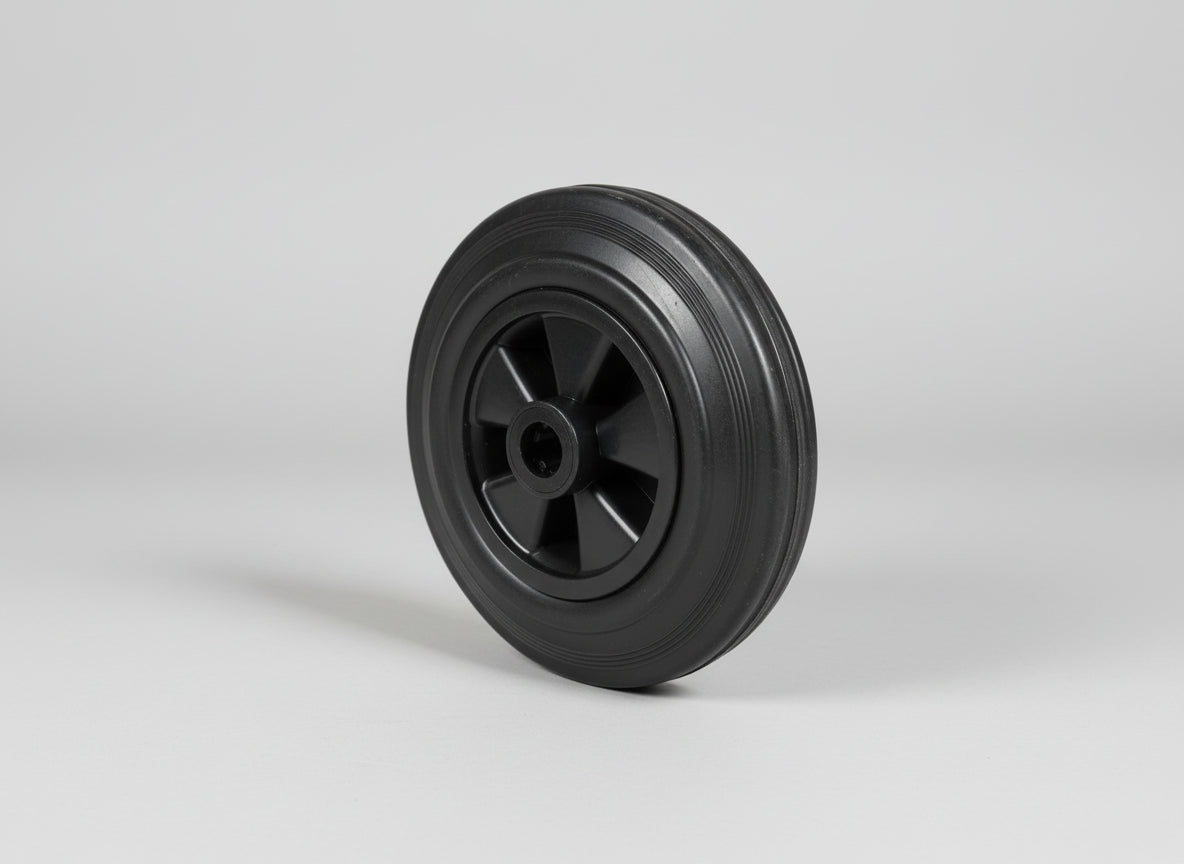
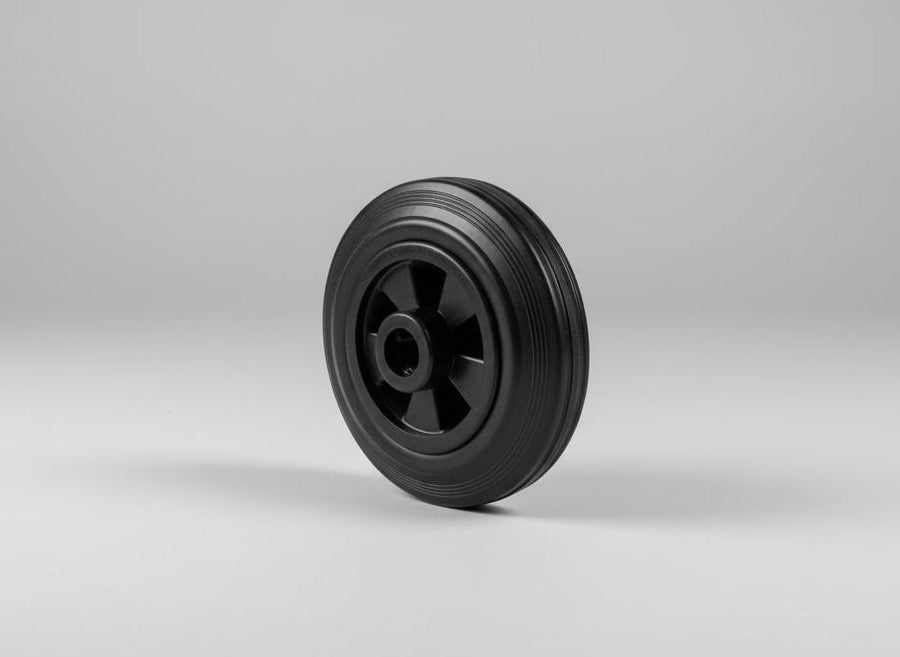
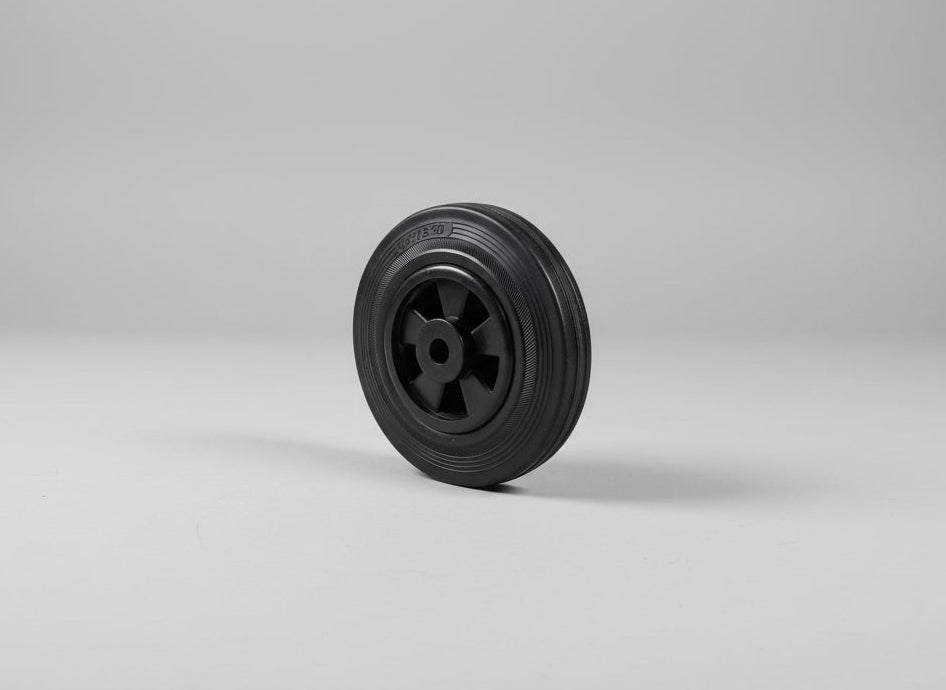
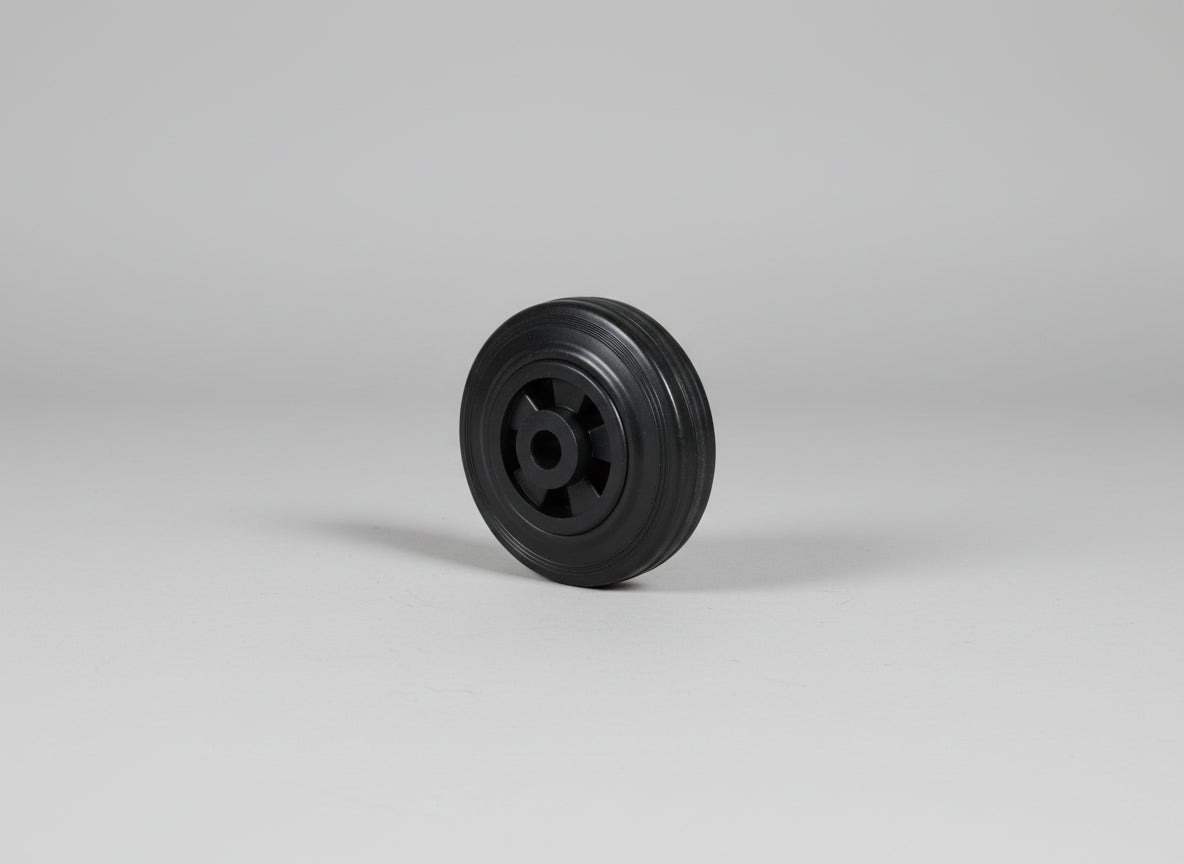
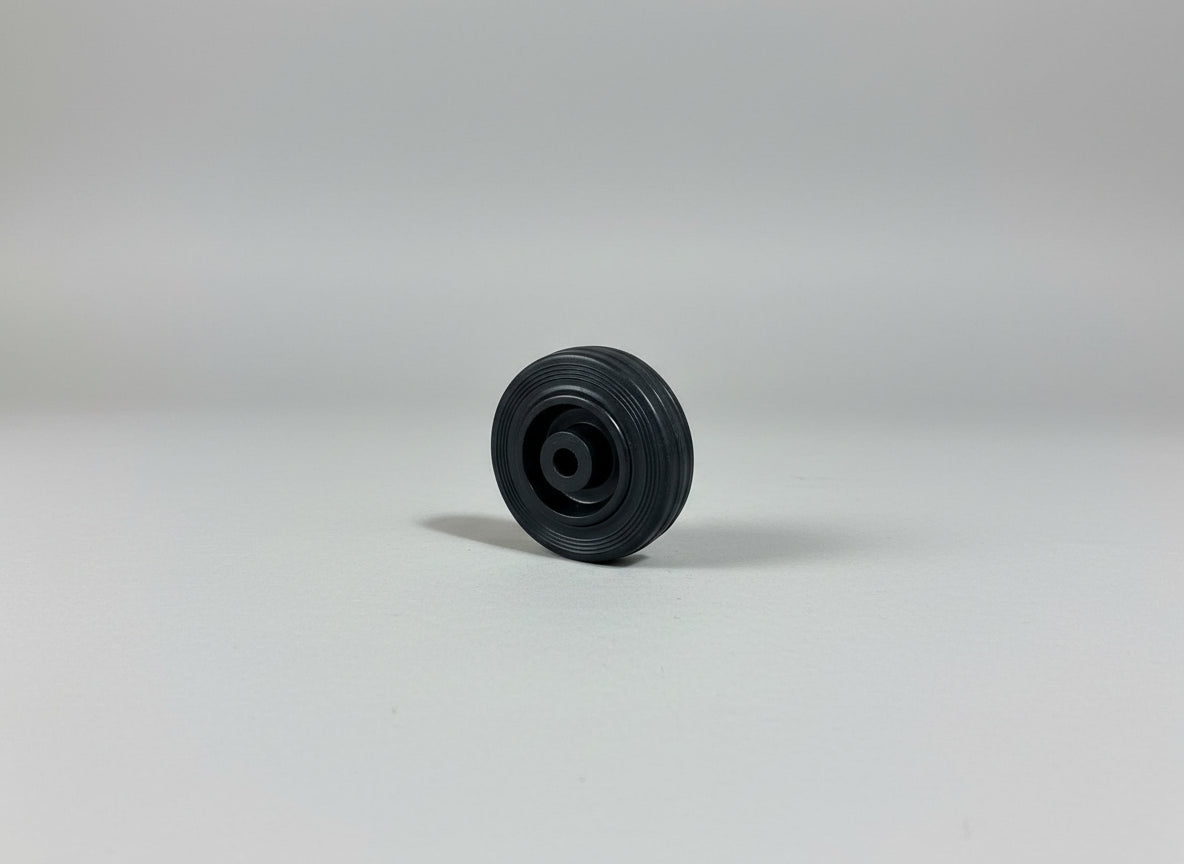
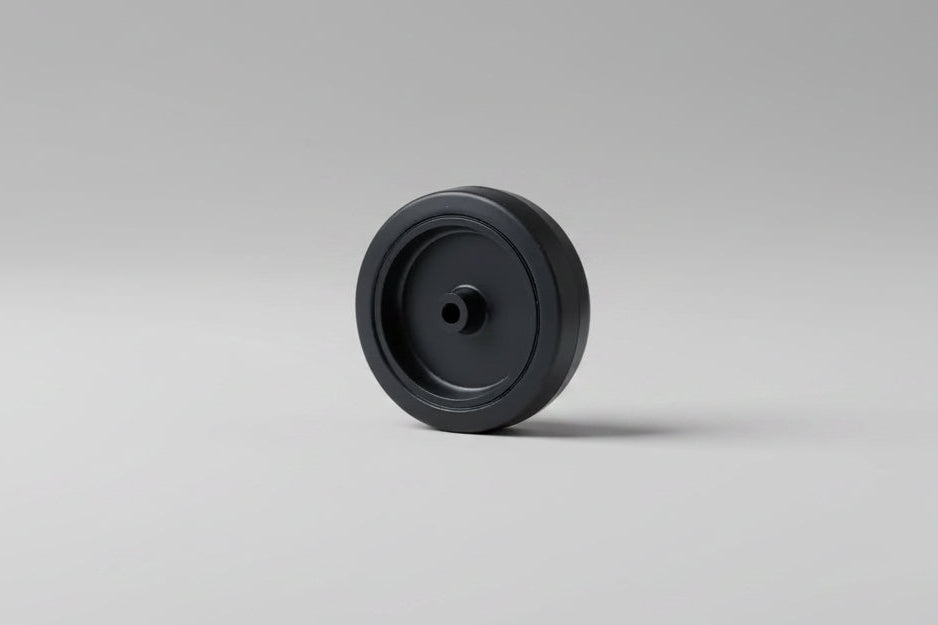
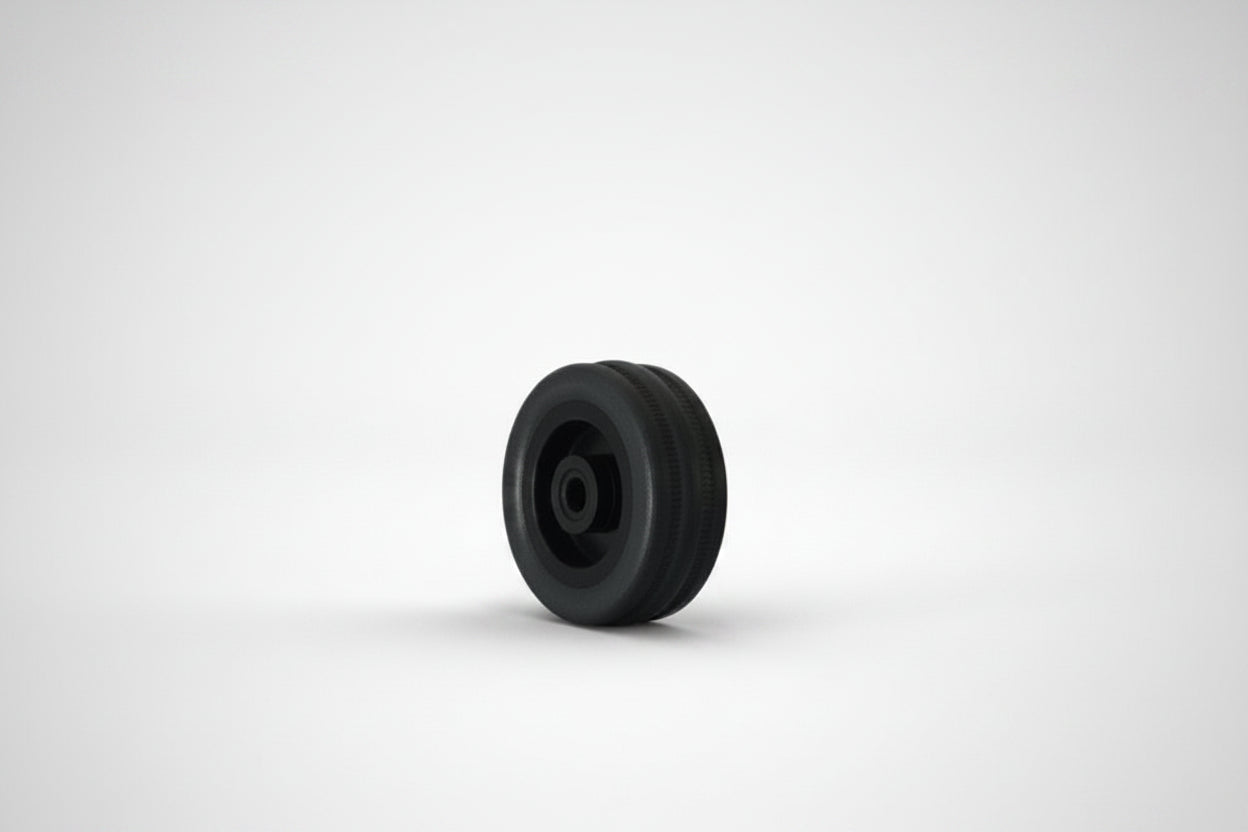
Sizes of 100mm, 125mm, 150mm, 160mm and 200mm, rated from 50kg to 200kg each. The black rubber tyre grips reliably on most surfaces, absorbs shock and vibration and gives quieter, smooth movement than a hard wheel - the reason rubber is chosen for retail, hospitality and any floor you would rather not scratch. Bear in mind that black rubber can mark light coloured floors; if that matters, the grey family below is non marking.
Bearings are plain or roller. The 100mm size comes in three versions - 8mm plain bearing at 50kg, 12mm plain bearing at 70kg and 12mm roller bearing at 70kg - and the 150mm has a 13mm plain bearing rated to 70kg. The 125mm roller bearing version is rated to 75kg on a 15mm bore, and the 160mm and 200mm roller bearing versions carry 160kg and 200kg on a 20mm bore. Where your axle is smaller than the bore, a steel reducing tube is available for the 100mm, 125mm, 160mm and 200mm sizes, taking 12mm down to 8mm, 15mm to 10mm and 20mm to 12mm - see reducing tubes in our hardware collection.
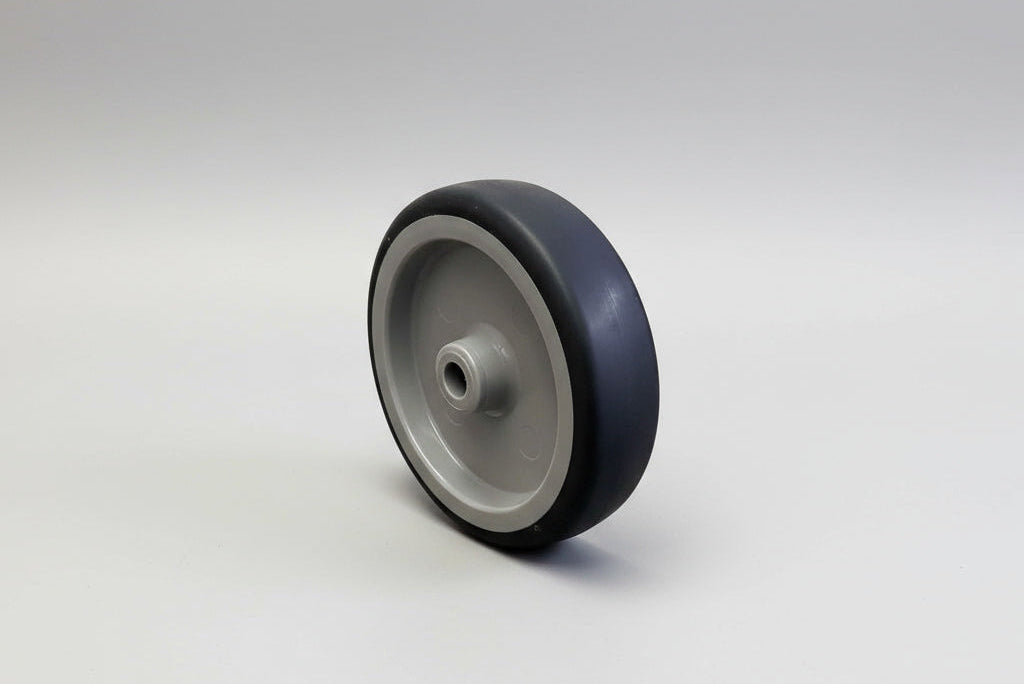
Sizes of 50mm, 75mm, 100mm and 125mm, rated from 40kg to 100kg. Each pairs a non marking thermoplastic rubber tread with a light grey polypropylene centre, which keeps it light and protects the floor from marks and damage. They are the usual choice as replacement castor wheels on lightweight trolleys, storage boxes, desks and mobile display cases, and for castors in schools, catering and healthcare, where thermoplastic rubber is the institutional standard for quiet, non marking wheels.
The 50mm is available with a 6mm or 8mm bore at 40kg, the 75mm has an 8mm bore at 50kg, the 100mm a 13mm bore at 80kg and the 125mm a 12mm bore at 100kg. The 100mm with an 8mm bore is available to order in larger quantities on a two week lead time - contact us.
At 50mm and 75mm the grey synthetic rubber family is light duty: 40kg to 50kg each, 18mm to 24mm treads, and small enough for the compact brackets used under furniture, storage boxes and display units - a cost effective fix for a scuffed or seized castor. The 100mm black rubber tyre with the 8mm plain bearing sits in the same class at 50kg. For anything with a stem fitting - an office chair, for instance - you need the complete castor, because the stem is part of the castor body.
The 160mm and 200mm black rubber tyres are the heavy duty end of this collection, rated to 160kg and 200kg on a 20mm roller bearing with a 60mm hub. A larger diameter rolls more easily, copes better with debris and needs less effort to get a heavy load moving, which is why bigger sizes suit warehouse, factory floor and logistics equipment, and the industrial machinery that travels any real distance - the mobility side of industrial applications. Heavier still, and you are into cast iron and polyurethane, which is what heavy duty castors run on - covered under materials below.
Castor wheels are not universal. Five measurements, all given in mm on the product page, decide whether a replacement fits the bracket and carries the load, so you can check an exact match before you buy.
Castors are named by wheel diameter, not overall height, so measure the tyre itself edge to edge in mm. A larger diameter rolls more easily and clears obstructions better, but it also raises the equipment, so if clearance is tight stay with the size you have. Sizes in this collection run from 50mm to 200mm.
The bore is the hole through the centre that the axle passes through; the hub length is the width of that centre from side to side. Both have to match the bracket. The bore size in this collection runs from 6mm to 20mm and hub lengths from 20mm to 60mm. If your axle is narrower than the bore of the size you want, a reducing tube bridges the gap on the black rubber tyre versions.
A wider tread spreads the load over more floor area, reducing pressure on soft or delicate surfaces, while a narrower tread swivels more easily. Treads here run from 18mm on the 50mm to 31mm on the 125mm grey; check that the new one clears the inside of the fork.
Load capacity comes first when handling heavy loads. Add the equipment's own weight to its maximum load to get the total weight, divide by three, because on uneven floors only three castors may carry the load at once, and choose a rating at or above that figure. Different load capacities are listed across this collection, from 40kg to 200kg each, so the load is matched size by size, and a stated load rating assumes rolling, not standing: equipment left loaded for months can flat-spot a softer wheel. When in doubt about the load weight, size up.
Bearings determine rolling effort. Plain bearings - the wheel turning directly on its centre - are simple, robust and the most popular choice. Roller bearings cut rolling resistance under heavy loads, and precision ball bearings give the easiest, smoothest motion of all. The stocked wheels are plain or roller bearing, so a heavy load rolls on rollers and a light load on a plain bore, and precision ball bearing versions are available on most sizes - if equipment is pushed by hand all day, ask us for one.
Wheel material decides what floor type it works best on, how much noise it makes and how long it lasts under the environmental conditions it runs in. Match the wheel to the floor: a hard one on a soft floor damages the floor, and a soft one on a rough floor wears out quickly.
Good shock absorption and noise reduction, floor protective on finished floors. Grey rubber is non marking; black rubber can mark light floors. Hard rubber carries more than soft rubber, at the cost of cushioning. Everything in this collection is rubber tyred; the same black, grey and blue elastic rubber tyres are fitted to complete castors on our rubber castors page.
The institutional standard: quiet, non marking, gentle on polished floors. Used in schools, catering and healthcare. The grey synthetic rubber tyres here are thermoplastic rubber.
A hard-wearing white nylon wheel or polypropylene wheel offers low friction and easy rolling, works well in wet conditions and resists chemicals, but transmits noise and can mark softer floors. Our white polypropylene and nylon sizes sit in trolley wheels.
High load capacity with floor protection, resistant to abrasion and rolling more easily than rubber under weight. A polyurethane tyre on a cast iron or steel centre is a common heavy duty combination for industrial applications. Solid polyurethane wheels in our puncture proof wheels collection give a cushioned ride with no flats.
The greatest load capacity of any common material and happy on rough, dirty or hot floors, but noisy and hard on finished floors, so they belong in foundries rather than commercial settings. Steel centres are also used beneath polyurethane wheels.
An air filled tyre that absorbs shocks on rough terrain, for sack trucks, wheelbarrows and garden equipment. See pneumatic wheels.
If the size you need is not in stock - a cast iron centre, a polyurethane tyre in a particular bore, an unusual hub length - get in touch. We can usually source it.
If the fork or the fitting is worn as well, replace the whole castor. Our industrial castors carry the same rubber tyres on pressed steel forks, as pressed steel swivel castors that rotate through 360 degrees, pressed steel fixed castors for straight line travel, or braked castors that hold equipment in place - most trolleys run a swivel fixed combination, two of each, with braked castors wherever equipment must stay put. Choose the fixing type to suit the equipment: plate fitting castors bolt through four fixing holes to flat-bottomed equipment, and industrial top plates follow standard bolt hole centres, so a replacement plate castor usually fits straight on without drilling; pressed steel bolt hole castors fix through a single central bolt hole, ideal for tubular frames. For 50mm castors under furniture and display units, see our budget plate fitting castors, and for quality castors that give equipment its mobility in the first place, the full guide to every type of castor, fitting and material is on our types of castors page.
Both spellings describe the same product. Castor is British English; caster is American. You will see both online, sometimes on the same listing, and UK suppliers, including QED, use castor.
Measure the one you are replacing: the diameter across the tyre, the bore through the centre, the hub length from side to side and the tread width, all in mm. Then compare those four figures against the specification on our product pages. If you are unsure, send us a photo and the measurements and we will identify a suitable replacement.
Yes, provided the fork and fitting are sound. The tyre and centre sit in the fork on an axle, and a replacement with the same diameter, bore and hub length takes its place. If the fork or the fitting is damaged, replace the complete castor instead.
No. They are made in many diameters, bores and hub lengths, and one only fits a bracket built for its dimensions. Diameter, bore and hub length must match; tread width must clear the fork; and the load rating must cover the equipment's total weight divided by three.
Anything that needs to roll: warehouse and platform trolleys, platform trucks, industrial machinery and maintenance equipment, catering and medical trolleys, retail display units, storage boxes, desks and furniture. The wheel is the part that meets the floor, so it is the part that takes the wear.
Most problems come down to the wrong material for the floor or the wrong rating for the load. A hard wheel marks a soft floor; a soft one wears quickly on a rough floor; a castor run over its load rating wears at best and fails at worst; and a soft one left loaded and stationary for months can flat-spot. Debris on workshop floors is the other culprit - a larger, harder wheel cuts through swarf and grit rather than picking it up.
We have made and supplied castors and wheels since 1987, as a family-run business, and we supply single castors and wheels as readily as full pallets. Every product is rated honestly at its stated load capacity, and for larger orders we can tailor almost any aspect of a castor - stem size, plate size, bolt hole size, even colour matching to your brand - thanks to our own UK tooling. Buying in volume? Bulk and trade pricing is available on the full range of stock. Browse the collection above, or contact our team on 01384 291143 with your measurements and quantities for a same-day quote.